
Core Modernization
Modernize your bank’s core ecosystem with a secure, API-first, cloud-native architecture, without disrupting customers or risking compliance.





Accelerate Your Transition to Cloud-Native Core Banking
Cicrim helps regional and community banks modernize core ecosystems by designing secure target architectures, reducing integration bottlenecks, and enabling API-first capabilities that support real-time digital experiences. Our approach prioritizes resilience, regulatory alignment, and a practical migration path that protects customers while unlocking speed and agility.
Whether you are preparing for a full core replacement, building a modern integration layer around an existing core, or improving data and channel interoperability, we deliver a modernization roadmap that your teams, and your examiners, can trust.
Is your bank’s core ecosystem built for real-time digital banking, modern integrations, and examiner-ready risk management?
Core modernization isn’t just a system swap, it’s the transformation of how your institution integrates, governs, secures, and scales technology across channels, data domains, vendors, and operational teams.
Cicrim helps banks move from brittle point-to-point integrations and legacy change cycles to a modern, composable architecture: API gateways, event-driven integration, secure cloud foundations, and a data strategy that supports analytics and AI, all aligned to FFIEC expectations and third-party risk practices.
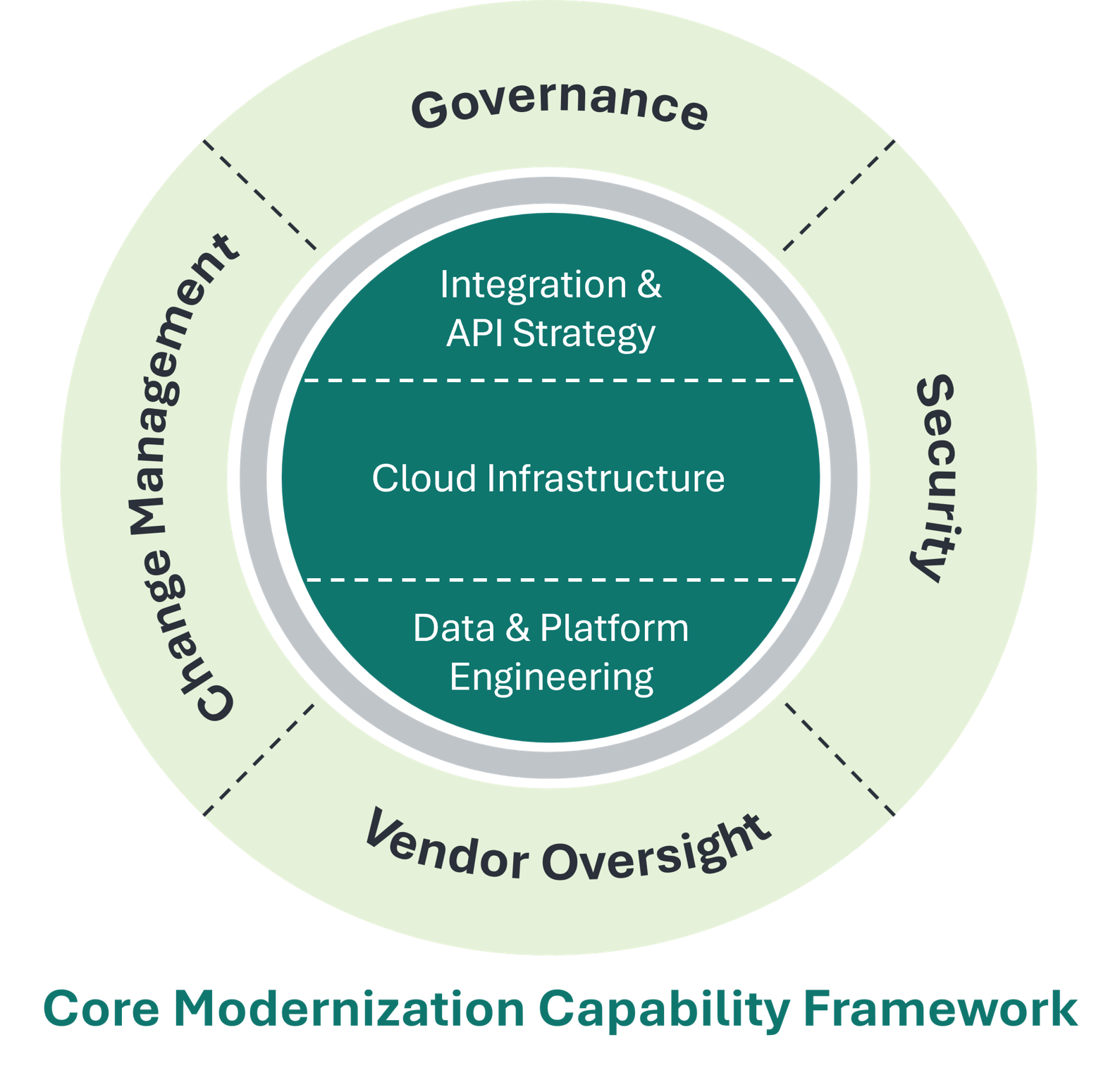
In the framework above, the outer layer represents the operating model required to modernize safely: Governance, security, vendor oversight, and change management. These are the foundations examiners expect, and the guardrails that keep modernization programs on track.
The inner layer represents the technical modernization levers: Integration and API strategy, cloud infrastructure, data architecture, and platform engineering. Together, they enable faster product delivery, improved resiliency, and clean interoperability across the bank’s ecosystem.
Core modernization is a growth and risk strategy
- Speed with control: Move faster without creating audit and operational debt. Standardize integration, versioning, and change management so new features can ship predictably.
- Resilience and reliability: Improve uptime and recovery by modernizing infrastructure, observability, and incident response, with clear ownership and tested runbooks.
- Regulatory alignment: Modernize in a way that stands up to scrutiny. Embed FFIEC-aligned controls, third-party risk governance, and documentation discipline so modernization reduces, not increases, examiner findings.
- Integration agility: Break the dependency chain. Move from fragile point-to-point connections to a scalable integration layer built on APIs and events, enabling faster vendor onboarding, safer releases, and cleaner channel expansion.
- Data and AI readiness: Prepare for analytics and AI at enterprise scale. Establish data contracts, lineage, and security boundaries that unlock trustworthy reporting, decisioning, and automation.
Core modernization is bigger than selecting a new platform. It’s an enterprise transformation that changes how your bank delivers products, integrates vendors, governs risk, and operates technology across teams. Cicrim helps you align business priorities to a modernization path that is realistic, phased, and defensible.
The benefits of a strong modernization strategy are felt across the bank
A focused modernization program reduces operational friction and improves delivery outcomes. When architecture, governance, and execution are aligned, technology becomes a multiplier, not a bottleneck.
1. Reduce operational and integration debt
Replace brittle point-to-point connections with a standard
integration approach that scales.
2. Improve change velocity and reliability
Establish repeatable release practices, automated testing, and
observability that make delivery predictable.
3. Strengthen resiliency and security posture
Modernize infrastructure and controls to improve uptime, recovery,
and audit readiness.
Five steps to a modernization program that works
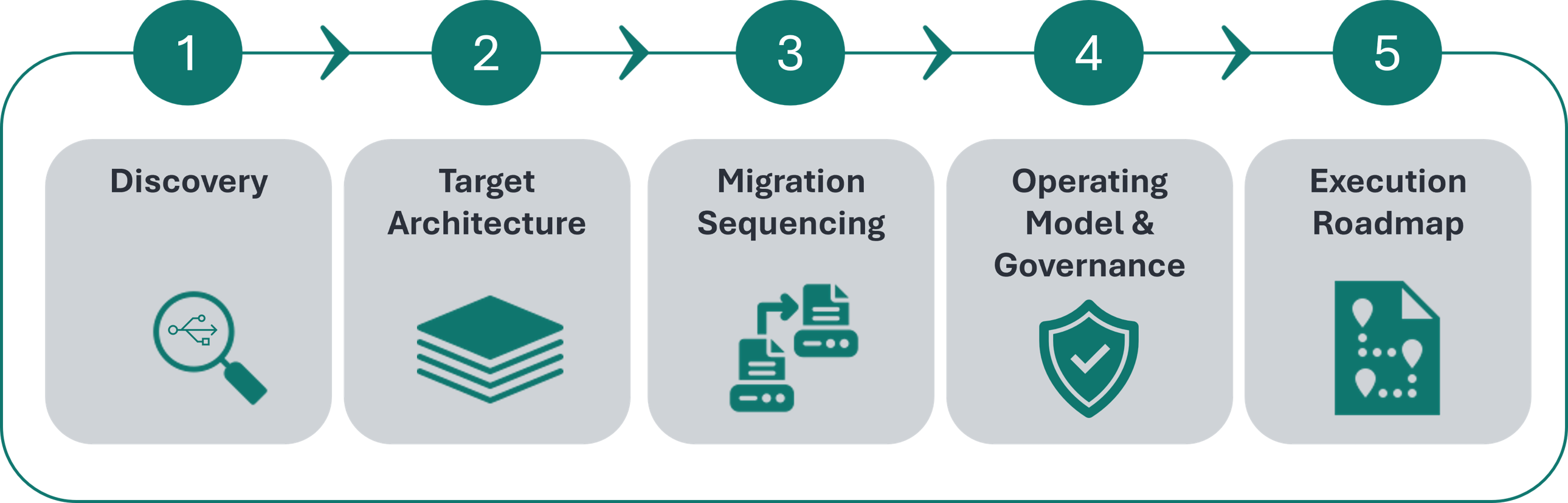
1. Discovery and risk-based prioritization
We assess current-state architecture, integration dependencies,
vendor landscape, and operational constraints. Then we prioritize
modernization initiatives based on risk reduction, business value,
and feasibility.
2. Target architecture and domain boundaries
We define the end-state blueprint: Core capabilities, integration
layer patterns, data domains, identity and access boundaries, and
control points. This establishes clarity before engineering begins.
3. Migration approach and release sequencing
We design a phased modernization path that often follows a strangler approach and
that minimizes disruption. This includes sequencing for channels,
integrations, data migration, and vendor cutovers.
4. Operating model and governance
We establish the modernization operating model: Architecture review,
change control, third-party oversight, documentation standards, and
engineering playbooks. This is where examiners gain confidence.
5. Implementation road map
We deliver a pragmatic 12–24 month roadmap with clear milestones,
measurable outcomes, and resourcing guidance. The roadmap includes
controls, testing, data, security, and cutover readiness, not just
technology tasks.
Modernization programs fail when governance is treated as an afterthought. Banking technology change requires discipline: Documented decisions, strong vendor oversight, and controls that align to FFIEC expectations.
Why governance is essential in core modernization
- Expanding vendor and API exposure: As the bank adds fintech integrations, APIs, and cloud services, the risk surface increases. Governance ensures the bank scales safely.
- Multiple teams producing change: Modern platforms accelerate delivery, but without standards, they also accelerate inconsistency. Governance establishes reusable patterns and review gates.
- Regulatory and audit expectations: Examiners expect clear ownership, tested controls, documented third-party oversight, and evidence of risk management throughout the program lifecycle.
- AI and automation dependencies: AI and decisioning systems rely on accurate data, defined policies, and controlled access. Governance is what makes automation trustworthy.
Governance focus areas
Cicrim implements governance as a practical operating system, not bureaucracy. We focus on evidence, accountability, and controls that support speed.
1. Program governance and steering cadence
Establish clear decision rights, escalation paths, and executive
reporting tied to measurable outcomes.
2. Architecture standards and review
Define patterns for APIs, events, identity, and data, with
lightweight review gates and documented decisions.
3. Vendor risk and contract controls
Embed due diligence, SOC report review, SLAs, exit planning, and
data handling requirements into the program.
4. Security controls and access management
Implement least privilege, key management, centralized logging,
monitoring, and segmentation aligned to banking standards.
5. Documentation and audit evidence
Create repeatable artifacts: System inventories, data flows,
control mappings, change records, and test evidence.
6. Operational readiness
Ensure incident response, DR testing, runbooks, and on-call
ownership are mature before cutovers.
For help aligning modernization to banking oversight expectations, explore our compliance resources.
Core ecosystems increasingly depend on integrations: Digital channels, payments, fraud tools, loan platforms, data services, and fintech partners. Cicrim designs integration architectures that reduce fragility and improve security, observability, and change velocity.
What is a modern integration layer?
A modern integration layer standardizes how systems communicate and how changes are deployed. It typically includes an API gateway, service orchestration, event streaming, identity controls, and monitoring. This reduces point-to-point risk and makes vendor onboarding faster and safer.
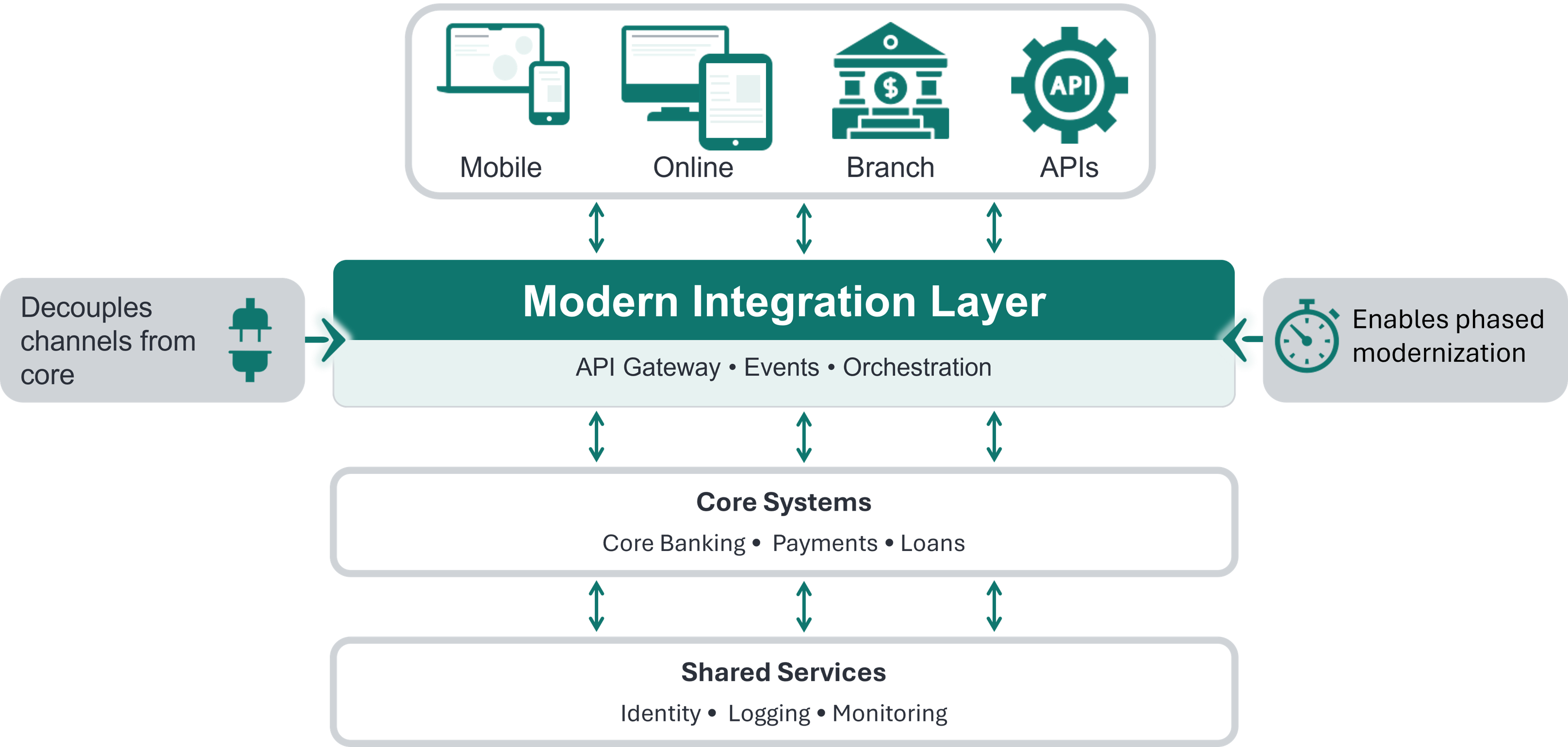
With the right patterns in place, the bank can modernize incrementally, improving channel performance and launching capabilities without waiting for a full core replacement.
Integration architecture also improves security posture by centralizing enforcement points: Authentication, authorization, throttling, auditing, and data loss controls.
Outcomes enabled by a modern integration layer
- Improved reliability: Reduce outages caused by brittle integrations and undocumented dependencies
- Reduced complexity: Standardize patterns and reduce undocumented data flows across vendors
- Speed to market: Deliver new channel features without rewriting the entire core stack
- Cross-domain insight: Support real-time reporting and event-driven monitoring across systems
Cloud modernization in banking requires more than moving existing systems unchanged. It requires secure landing zones, identity boundaries, encryption strategy, logging, monitoring, and repeatable infrastructure deployment. Cicrim designs cloud foundations that support both modernization velocity and regulatory expectations.
Obtaining full value from cloud modernization
Build the foundation
Establish secure landing zones, network segmentation, key
management, centralized logging, and policy enforcement. This
becomes the platform your modernization program can safely scale
on.
Enable adoption
Provide repeatable Infrastructure as Code templates, CI/CD, and operational runbooks.
We help teams adopt a platform operating model so systems are consistent,
observable, and supportable.
Modernization examples

Modern core ecosystems produce real-time signals: Transactions, channel events, operational metrics, and customer interactions. To unlock value, banks need a secure data architecture with lineage, access boundaries, and consistent definitions, so analytics and AI can be trusted.
Step 1: Define decision use cases
Identify the decisions that matter: Growth, risk, fraud, service,
and operational efficiency. Then map the data signals and control
requirements required to support those decisions.
Step 2: Build the data architecture and controls
Design ingestion, storage, governance, and access policies that
support reporting and decisioning. This includes data contracts,
quality rules, and audit evidence.
Step 3: Implementation road map
Translate architecture into a phased plan with measurable outcomes:
Faster reporting, improved risk monitoring, and AI-enabled
workflows, with controls embedded from day one.
To align data modernization with your broader program, explore our AI Stack Design and AI Compliance Solutions services.
Contact us and we’ll help you design a modernization roadmap that is safe, practical, and exam-ready.

AI Stack Design
Modern core ecosystems create the foundation for AI, but only when data, identity, security, and integration are designed intentionally. Cicrim helps banks design AI-ready architectures that are safe, governed, and aligned to operational reality.
What core modernization looks like in practice
Technology ecosystem modernization

Cloud Platforms
Modern core ecosystems rely on secure cloud foundations, policy enforcement, and resilient platform design.

Integration & API Management
Standardize APIs, events, security, and observability to reduce integration debt and accelerate delivery across vendors and channels.

Data, Analytics & Observability
Build trusted data foundations with lineage, controls, and monitoring to support reporting, risk detection, and AI readiness.

Identity & Access Management
Enforce least privilege, strong authentication, and centralized policy controls across modern apps, APIs, and third-party integrations.

Security & Monitoring
Centralize logging, threat detection, and alerting with bank-grade controls, supporting resilience, audits, and incident response readiness.

Payments & Fraud Controls
Integrate modern payments, real-time monitoring, and fraud tooling with clean data flows, without brittle point-to-point dependencies.
Migration & Platform Engineering
Implement phased migration patterns, CI/CD guardrails, and platform engineering practices that improve delivery speed while keeping risk controlled.

AI Compliance Solutions
Modernization accelerates change, and change increases risk if controls aren’t designed in. Cicrim helps banks implement governance, documentation, and control evidence that keeps modernization programs aligned to examiner expectations.
Explore related Cicrim services

AI-Powered Decisioning
Improve underwriting, monitoring, and operational decisions with governed AI and high-quality data foundations.

Digital Lending Platform
Modernize loan origination and servicing with workflows, integrations, and controls that scale.

AI-Driven Engagement
Improve customer experiences across channels with governed personalization and workflow automation.

AI Compliance Solutions
Build examiner-ready governance, documentation, and control evidence for AI and modernization programs.
AI Observability
Monitor model behavior, data quality, control performance, and accountable remediation in production.